
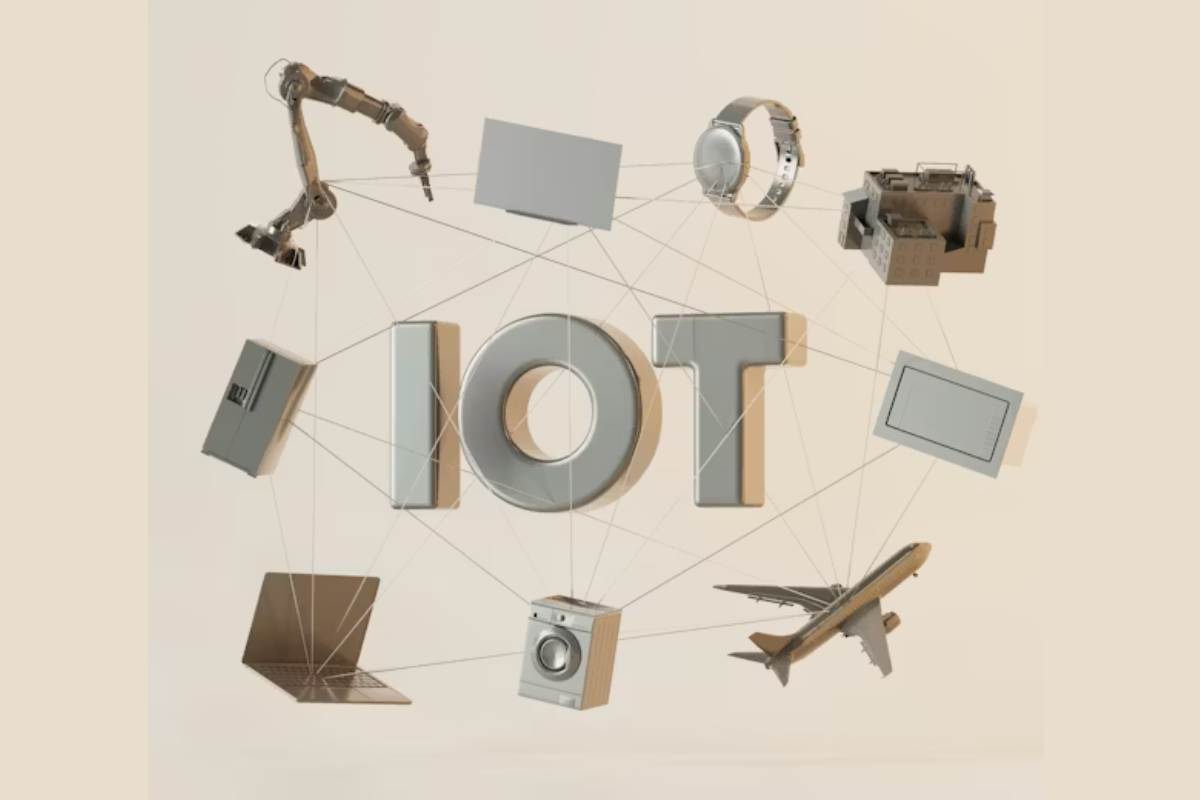
Kevin Ashton first introduced the concept of the Internet of Things (IoT) in 1999. IoT refers to billions of devices connected to the internet that collect, transmit, and exchange data. However, IoT gained popularity after Gartner included it in its list of promising emerging technologies in 2011.
5G technology is used across sectors such as manufacturing, agriculture, healthcare, transportation, water and wastewater, media, retail, energy distribution, and more.
What is IOT?
The Internet of Things (IoT) is the interconnection of physical objects—”things”—integrated with software, sensors, and various technologies to connect, transform, and transmit data to multiple devices and systems over the internet.
These objects can be anything from everyday items to large-scale industrial equipment. Home security systems, motion sensors, Alexa, and Google Assistant are popular examples of the IoT.
Why Is IoT so Important?
We connect everyday objects to the internet through embedded devices, enabling seamless communication between people, processes, and things.
In this era of hyperconnectivity, digital systems can track objects with minimal human intervention. Physical objects can exchange data, connect to the network, and transmit it with minimal human intervention. This is only possible thanks to affordable computing resources, cloud, and mobile technologies.
How Does 5G Technology Enhance The Internet of Things (IoT)?
Data transmission technology plays a key role in the Internet of Things (IoT). This makes 5G communication technology crucial for the IoT. 5G makes connections faster and more efficient, and reduces latency.
Here Are a Few Ways 5G Enhances the Internet of Things:
- Increased throughput: 5G delivers significantly higher throughput than previous generations, enabling higher data rates, faster data transfer, and higher image and video resolution.
- Faster connectivity: 5G technology increases connection speeds, making it ideal for applications that require real-time data transfer, such as virtual reality.
- Lower latency: 5G delivers lower latency than previous generations, which is vital for specific applications. This also makes applications more responsive and accurate.
- Enhanced security: 5G technology features improved security features such as authentication and encryption, making it more difficult for hackers to compromise IoT networks.
- Cost Reduction: 5G technology has the potential to reduce the cost of IoT networks. 5G can help reduce infrastructure costs and virtually eliminate the need for additional equipment.
- Increased Scalability: 5G technology also improves scalability, enabling the development of more complex applications and larger networks.
- Location Services: 5G technology also enhances location services, enabling IoT devices to obtain precise location information.
- Expanded Coverage: It extends the coverage and range of IoT networks and increases device density, facilitating the development of complex applications.
5G technology delivers higher speeds, lower latency, and greater throughput, which is crucial for the development of the Internet of Things.
5G technology can achieve peak data rates of up to 20 Gbps and average rates of over 100 Mbps, significantly faster than 4G networks, delivering higher throughput and allowing more devices to connect to the network simultaneously. As 5G technology matures, the Internet of Things will become even more powerful and advanced.
Advantages and Disadvantages of Internet of Things:
Advantages:
- The main advantage of the Internet of Things (IoT) is data tracking. This helps obtain information that is difficult to gather by other means.
- Easy access to real-time information is possible from virtually anywhere in the world, as long as a person has a modern device and an internet connection.
- The IoT enables seamless, uninterrupted automation, as repetitive processes can be fully automated.
- The IoT helps people better manage their time. For example, if a person wants to add items to their shopping list, they can do so using voice commands and Alexa.
- Without human intervention, machines communicate with each other, enabling quick, timely decisions.
- The IoT makes our systems more efficient.
Disadvantages:
- Data can easily be compromised when personal information is exposed. Credit card numbers are the most frequently compromised information online.
- Dependence on smart devices can increase dramatically. The Internet of Things has significantly reduced our attention span.
- Because the Internet of Things is a heterogeneous network of interconnected devices, designing, developing, maintaining, and operating a large-scale IoT system can be challenging.
- IoT devices require a constant power supply and an internet connection to function properly, which can cause problems during outages.
- IoT has made everyone lazy and overly dependent on technology to perform everyday tasks.
- As manufacturers configure IoT devices differently, compatibility issues arise, and developing solutions increases costs and time.
- Everyone is controlled and dependent on technology.
Applications of Internet of Things:
Internet of Things devices are used in every possible field of day-to-day life. Listed below are some of its applications:
- Smart locks and door access control systems are among the most popular and cost-effective Internet of Things (IoT) solutions. They are easy to implement and control using web interfaces or smartphone apps.
- Bright lighting is a beautiful IoT-enabled home application. It helps save energy and manage it more efficiently.
- Smartphone apps allow you to adjust, dim, and control lighting to suit your mood and surroundings.
- Using IoT and sensor technologies, doors can be opened and closed using smartphone apps, eliminating the need to open or close them manually.
- IoT devices analyse traffic over time to provide updates on peak traffic levels along common travel routes.
- The Internet of Things (IoT) is being used in hospitals to address critical challenges. Real-time diagnostics can be performed using IoT devices.
- Doctors can quickly access a patient’s medical history to prescribe appropriate treatment.
- Automated driving is advancing thanks to artificial intelligence and advanced sensor technologies in the Internet of Things.
- Automated functions reduce workload and personnel costs.
- A sustainable approach is possible through the use of IoT, as it improves efficiency and effectiveness and identifies problem areas for treatment in real time.
- Farmers are using intelligent methods and technologies to meet current and future agricultural needs.
- Smart cars are a great example of how the IoT is being used to control, monitor, and drive a vehicle using sensors and a central computer installed in the car.
Narrowband – Internet of Things:
Narrowband IoT (NB-IoT) is a standardised technology with low-power wide-area (LPWA) capabilities designed to support a wide range of emerging IoT devices and services.
NB-IoT reduces the power consumption of user devices while increasing bandwidth efficiency and system throughput, especially in deep coverage areas. It is a standard developed by the 3rd Generation Partnership Project (3GPP) and is part of the LTE (Long Term Evolution) family of wireless technologies.
NB-IoT aims to extend coverage beyond the limits of existing cellular technologies. It also provides repeatability and multi-band allocation for high-speed data transmission. In many use cases, devices connected to NB-IoT can have a battery life of over ten years.
Overall, NB-IoT provides cost-effective and reliable solutions for connecting IoT devices, enabling widespread adoption and supporting the development of new IoT applications.
Conclusion:
The Internet of Things is a platform that connects the modern world and real-time life using RFID technologies, artificial intelligence, sensors, connectivity, and communication devices. Demand for IoT will continue to grow in the coming years as everyone seeks a better life and lifestyle. If you want to learn more about the Internet of Things, you can refer to the book “The Internet of Things,” which explains the IoT well.
5G technology is essential for the successful implementation of IoT. It has enabled IoT devices to achieve higher data transfer speeds, lower latency, and lower costs. IoT improves industrial equipment, increasing its efficiency and functionality. IoT has revolutionised the hospitality industry by providing real-time solutions.